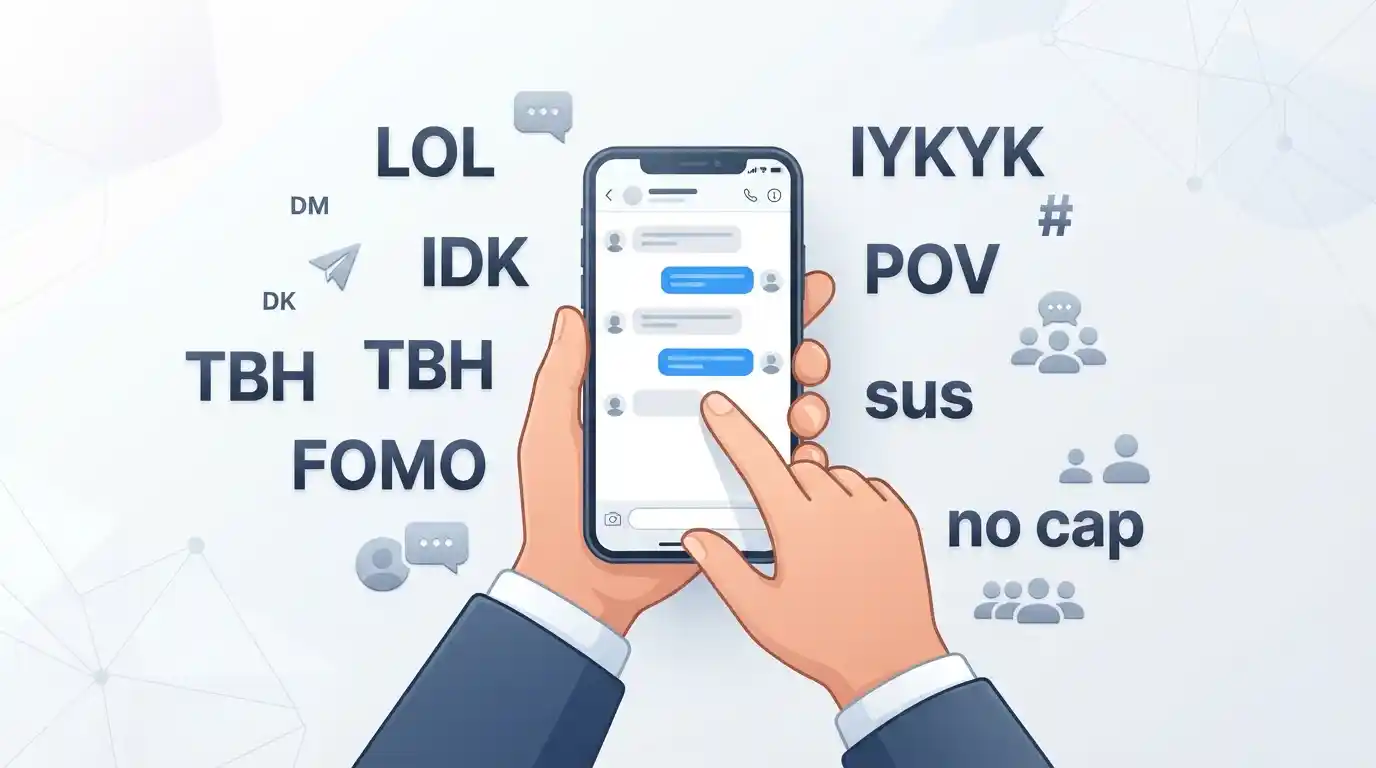
Social media slang means informal words, phrases, abbreviations, acronyms, and expressions used in online posts, comments, DMs, texts, and chats. Examples include LOL, TBH, FOMO, POV, IYKYK, sus, slay, and no cap.
Key Takeaways
- Social media slang is a broad category of informal online language rather than one specific abbreviation.
- It includes acronyms, texting shortcuts, shortened words, phrases, memes, and platform-specific expressions.
- The same term can have different meanings depending on the conversation, platform, or community.
- Social media slang commonly appears in DMs, comments, captions, group chats, posts, and online communities.
- Most slang is casual and works best in informal conversations rather than professional or formal writing.
- Context matters because slang can sometimes have multiple meanings or carry a tone that is difficult to understand from the words alone.
Social Media Slang Meaning in Text
Social media slang refers to informal language people use to communicate quickly, casually, humorously, or expressively online. It includes texting abbreviations such as BRB and IDK, acronyms such as FOMO and TBH, and slang expressions such as no cap, sus, slay, and IYKYK.
It is best understood as an umbrella term for different forms of online communication. Not every social media slang term is an acronym, and not every abbreviation is slang.
For example:
- LOL = Laughing Out Loud
- IDK = I Don’t Know
- TBH = To Be Honest
- FOMO = Fear Of Missing Out
- POV = Point Of View
- IYKYK = If You Know, You Know
- sus = suspicious or questionable
- no cap = honestly or without exaggeration
- slay = do something exceptionally well or look especially good
The meaning of a slang term can depend heavily on context. A word that seems confusing by itself may become obvious when you look at the surrounding message, emoji, punctuation, or conversation topic.
Social media slang is generally casual and informal. Some expressions are widely understood, while others are associated with particular online communities, trends, platforms, or moments in internet culture.
What Does Social Media Slang Stand For?
Social media slang does not have one full form. It is a general term describing informal language used across social networks and online communication.
Individual slang terms can have their own full forms. For example, LOL stands for “Laughing Out Loud,” while FOMO stands for “Fear Of Missing Out.”
Other social media slang is not based on an acronym at all. Terms such as slay, sus, and no cap function as words or phrases rather than traditional abbreviations.
So, “social media slang” should not be treated like an acronym with one fixed expansion.
How Is Social Media Slang Used?
Social media slang can appear almost anywhere people communicate online.
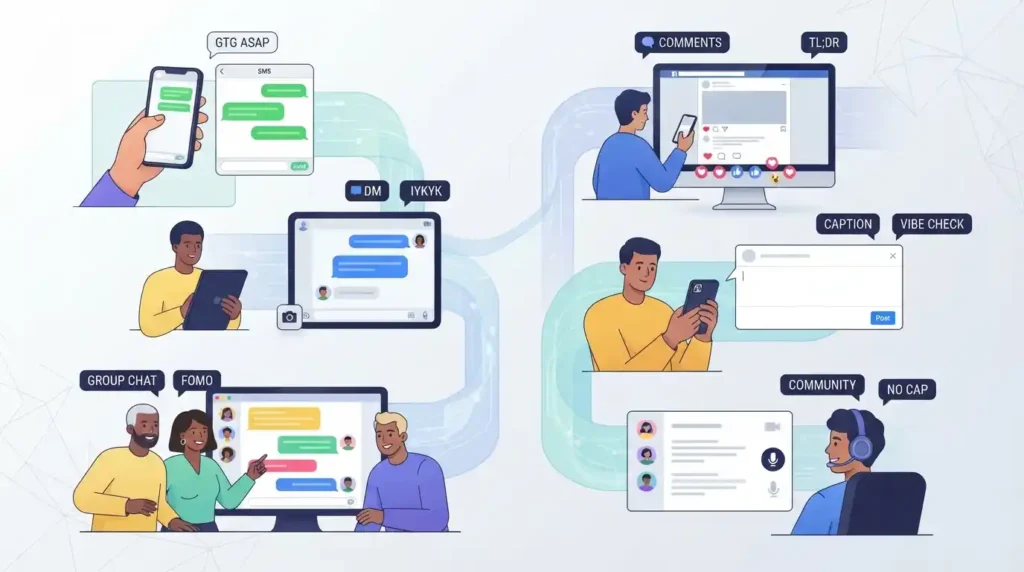
Text Messages
People use slang and abbreviations to make personal messages shorter and more conversational.
“IDK if I can make it tonight.”
“TBH, that movie was actually good.”
DMs
Direct messages often contain casual shorthand because people are having informal conversations.
“WYD later?”
“OMG you have to see this 😂”
Group Chats
Friends may use slang to react quickly or make jokes.
“That was wild 💀”
“FR, I was not ready for that.”
Social Media Comments
Slang is common in reactions to videos, photos, posts, and memes.
“This is so relatable 😭”
“Bro really ate with this one.”
Captions and Posts
Creators may use expressions such as POV, IYKYK, TBH, FOMO, or no cap to make captions shorter or more conversational.
Gaming and Online Communities
Some slang overlaps with gaming and internet culture. Terms such as GG, AFK, OP, and NPC can appear in gaming conversations as well as broader online discussions.
The exact meaning should always be judged from context rather than the platform name alone.
Social Media Slang in Different Contexts
The meaning of slang is often easier to understand when you consider who sent it, what came before it, and what the conversation is about.
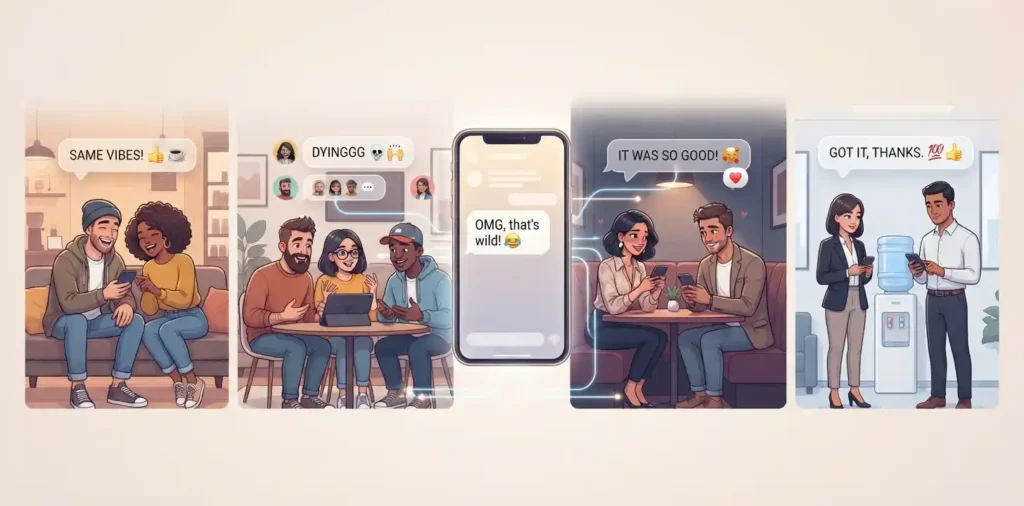
From a Friend
A friend might use slang simply to sound casual.
“Bro that was hilarious 💀”
This is normally an informal reaction rather than a statement with hidden meaning.
From a Guy or Girl
The basic meaning of a slang term does not automatically change because the sender is a guy or girl.
For example, LOL still means “Laughing Out Loud” regardless of who sends it.
The surrounding conversation may provide additional meaning, but the slang itself does not prove romantic interest.
From a Crush
Slang can appear in flirting or casual conversation with a crush, but it should not automatically be interpreted as flirting.
“You really ate with that outfit 🔥”
The overall conversation, relationship, emojis, and previous messages matter more than the slang alone.
In Dating
People may use casual expressions such as FR, TBH, WYD, WYA, or IYKYK during dating conversations.
However, a slang abbreviation by itself does not prove attraction, commitment, rejection, or romantic intent.
In a Group Chat
Slang can make group conversations faster and more playful.
“Y’all are wild 😂”
“FR tho, what happened?”
In Social Media Comments
Comment sections often use short reactions, memes, abbreviations, and expressions that may depend on the specific online community.
That means a term can sometimes have a meaning in one community that differs from its meaning elsewhere.
Real Chat Examples
Here are realistic examples showing how social media slang can appear in everyday online communication:
- “LOL I can’t believe you actually did that.”
LOL means “Laughing Out Loud.” - “IDK what time I’ll be home.”
IDK means “I Don’t Know.” - “TBH, I liked the first one better.”
TBH means “To Be Honest.” - “FR, that was the funniest part.”
FR means “For Real.” - “WYD tonight?”
WYD means “What You Doing?” or “What Are You Doing?” - “WYA? We’re already here.”
WYA means “Where You At?” - “OMG look at this video 😂”
OMG means “Oh My God.” - “I have major FOMO seeing everyone’s pictures.”
FOMO means “Fear Of Missing Out.” - “POV: You finally finished your homework.”
POV means “Point Of View.” - “IYKYK 😂”
IYKYK means “If You Know, You Know.” - “No cap, that was actually amazing.”
No cap means the person is being honest or not exaggerating. - “That sounds kinda sus.”
Sus means suspicious or questionable. - “You absolutely slayed that presentation.”
Slayed is being used as praise for doing something very well. - “BRB, someone’s calling me.”
BRB means “Be Right Back.” - “SMH, why would he post that?”
SMH means “Shaking My Head.” - “NGL, I didn’t expect that ending.”
NGL means “Not Gonna Lie.” - “This meme is sending me 💀.”
The expression indicates that something is extremely funny or entertaining. - “That outfit is fire 🔥.”
Fire is slang for something excellent, impressive, or stylish. - “She really understood the assignment.”
This means she did something particularly well or matched the expectations of the situation. - “That’s so me 😭.”
This indicates strong personal identification with or relatability to the situation.
How to Reply to Social Media Slang
Because social media slang covers many different expressions, your reply should match the specific term and conversation.
Casual Replies
- “Haha, same.”
- “FR 😂”
- “I know right?”
- “Exactly.”
- “For real.”
Friendly Replies
- “LOL, I was thinking the same thing.”
- “You already know 😂”
- “That’s actually so true.”
- “I had the same reaction.”
Funny Replies
- “Bro 💀”
- “You’re actually wild.”
- “I’m crying 😂”
- “Not you saying that 😭”
Neutral Replies
- “Got it.”
- “Makes sense.”
- “Okay, I understand.”
- “Thanks for explaining.”
Flirty/Relationship Replies
If the conversation is already clearly romantic, you can match that tone:
- “Oh, so that’s how you feel? 👀”
- “You’re kinda cute when you say that.”
- “IYKYK 😉”
- “You’re making this interesting.”
A slang term alone should not be treated as proof that someone is flirting. Look at the complete conversation before deciding what the sender means.
What Tone Does Social Media Slang Have?
Social media slang is usually casual and informal, but its exact tone depends on the expression.
Common tones include:
- Casual: “IDK, maybe later.”
- Friendly: “LOL that’s hilarious.”
- Playful: “Bro really thought he ate 😂”
- Excited: “This is fire!”
- Sarcastic: “Yeah, because that’s definitely going to work 💀”
- Direct: “TBH, I don’t like it.”
- Context-dependent: “Sus” can be playful or genuinely suspicious depending on the conversation.
Emojis, capitalization, punctuation, and the relationship between the people involved can also affect how a slang expression feels.
Is Social Media Slang Rude or Offensive?
Most social media slang is not inherently rude or offensive, but some individual expressions can contain profanity, sexual references, insults, or culturally sensitive language.
For casual conversations with friends, slang is usually acceptable when everyone understands the tone.
Social media slang can also be appropriate in many comments, DMs, and informal online conversations. However, professional settings are different.
For school, work, business communication, applications, formal emails, and other professional writing, standard language is usually safer unless the audience clearly expects a casual tone.
The important distinction is that “social media slang” is a broad category. The appropriateness of a particular term depends on the term itself, the audience, and the situation.
Other Meanings of Social Media Slang
“Social media slang” is not normally used as an acronym with a separate technical expansion. It describes a category of language.
However, individual terms within this category may have different meanings outside social media.
For example:
- DM can refer to a direct message online but can have other meanings in different fields.
- OP can mean “original poster” on social platforms but may have another meaning in gaming or other contexts.
- BTS can mean “behind the scenes” online, while BTS is also widely recognized as the name of a music group.
- IRL means “in real life” in internet communication and contrasts with online activity.
When a specific abbreviation has several meanings, context is the best way to determine which one applies.
Common Mistakes About Social Media Slang
Assuming Every Short Word Is an Acronym
Not all social media slang is an acronym. LOL and FOMO have established expansions, while sus and slay are slang words.
Assuming Every Term Has One Meaning
Some abbreviations can mean different things in different conversations. Context should be checked before choosing an interpretation.
Assuming Slang Proves Romantic Interest
A person using WYD, FR, TBH, or another casual term does not automatically mean they are flirting.
Treating Internet Slang as Professional Language
A phrase that works perfectly in a group chat may sound too casual in a job application or professional email.
Assuming Everyone Uses the Same Slang
Online language varies across communities, platforms, age groups, interests, and regions. A term familiar to one group may be unfamiliar to another.
Social Media Slang and Related Terms
| Term | Meaning | Common Use |
|---|---|---|
| Texting slang | Informal language used in text messages | Texts and chats |
| Internet slang | Informal language that develops or spreads online | Websites, forums, social media |
| Texting abbreviation | A shortened form used in messages | SMS and messaging |
| Acronym | A shortened expression formed from letters | Texts, posts, chats |
| Online slang | Casual language used in digital communication | Social platforms and communities |
| Chat slang | Informal expressions used during online conversations | DMs and group chats |
These terms overlap, but they are not always interchangeable. Social media slang is a broad category that can include several of them.
People Also Ask About Social Media Slang
What is social media slang?
Social media slang is informal language used in online communication. It includes abbreviations, acronyms, shortened words, phrases, memes, and expressions used in posts, comments, DMs, and chats.
What are some examples of social media slang?
Examples include LOL, IDK, TBH, FOMO, POV, IYKYK, sus, slay, no cap, and FR. Their meanings and tone can depend on the context.
Is social media slang the same as texting slang?
They overlap, but they are not exactly the same. Texting slang is primarily associated with text-based messaging, while social media slang also includes expressions used in captions, comments, posts, memes, and online communities.
Why do people use social media slang?
People use slang to communicate quickly, sound casual, express emotion, participate in online culture, or fit the style of a particular community. Some expressions also make messages feel more humorous or conversational.
Can social media slang have multiple meanings?
Yes. Some abbreviations and expressions have more than one possible interpretation. The surrounding conversation, platform, punctuation, emojis, and topic can help determine the intended meaning.
Is social media slang appropriate at work?
Some familiar abbreviations may be understood at work, but slang is generally more appropriate for informal communication. For formal emails, reports, applications, and professional documents, standard language is usually the safer choice.
Does social media slang mean the same thing everywhere?
No. Meanings can vary between online communities and contexts. A term may be common in one group while unfamiliar or differently interpreted in another.
Conclusion
Social media slang is a broad category of informal online language that includes acronyms, abbreviations, shortened words, phrases, and internet expressions. Terms such as LOL, TBH, FOMO, POV, IYKYK, sus, and no cap can make digital conversations faster and more expressive.
There is no single full form for social media slang because it is a category rather than one acronym. Its meaning and tone depend on the specific expression and context. It is generally best suited to casual online communication, while more formal situations usually call for standard language.

For three and a half years, Charlotte Reed has worked as a writer shaping puns and jokes around distinct subjects and vocabulary. She covers food, animals, seasonal themes, technology, entertainment, and trending topics. Her process includes examining topic-specific language, building wordplay from relevant terms, and editing punchlines for sharper phrasing, structure, and comedic timing.