Everyday Chat Slang refers to informal words, abbreviations, short phrases, and messaging shorthand commonly used in casual online conversations. Examples include LOL, IDK, BTW, BRB, TBH, RN, OMG, and TTYL.
Key Takeaways
- Everyday Chat Slang is a descriptive term, not one specific abbreviation or acronym.
- It covers informal language used in texts, DMs, group chats, comments, and social media.
- Common examples include LOL, BRB, IDK, BTW, OMG, RN, TBH, and TTYL.
- The meaning or tone of a slang term can change depending on the sentence, relationship, and conversation.
- Most chat slang is casual and works best in personal conversations rather than formal writing.
- A short reply does not automatically indicate anger, flirting, rejection, or another hidden emotion.
Everyday Chat Slang Meaning in Text
Everyday Chat Slang means the informal vocabulary people use to communicate quickly and casually through digital messages. It includes text slang, internet slang, texting abbreviations, messaging shorthand, short replies, and informal expressions.
Unlike a term such as LOL, Everyday Chat Slang does not have one fixed full form. It is a category or descriptive phrase for common language used in everyday digital conversations.
Some examples include:
| Chat Slang | Meaning |
|---|---|
| LOL | Laughing out loud |
| BRB | Be right back |
| IDK | I don’t know |
| BTW | By the way |
| OMG | Oh my God |
| TBH | To be honest |
| RN | Right now |
| TTYL | Talk to you later |
| NGL | Not gonna lie |
| LMK | Let me know |
| WDYM | What do you mean? |
| IKR | I know, right? |
| FR | For real |
| FYI | For your information |
| OMW | On my way |
The exact choice of slang depends on the person, conversation, platform, and situation.
What Does Everyday Chat Slang Stand For?
Everyday Chat Slang does not stand for a specific phrase. It is not a traditional acronym or initialism.
The phrase simply describes the casual words and shortcuts people use in everyday digital communication. Individual examples within this category can have their own expansions.
For example:
- BRB stands for “Be right back.”
- IDK stands for “I don’t know.”
- TBH stands for “To be honest.”
- BTW stands for “By the way.”
- TTYL stands for “Talk to you later.”
So, if someone asks for the “full form of Everyday Chat Slang,” there is no single full form to provide.
How Is Everyday Chat Slang Used?
Everyday chat slang is mainly used to make informal conversations shorter, faster, and more relaxed.

Text Messages
People commonly use abbreviations in everyday texting.
“BRB, I have to grab something.”
“IDK what time we’re leaving.”
DMs
Direct messages often contain casual slang because the conversation is personal and informal.
“NGL, that was actually funny.”
Group Chats
Group conversations frequently use quick reactions and short forms.
“LOL you guys are wild.”
“LMK when you’re ready.”
Social Media
Slang can appear in comments, captions, replies, and private messages.
“FR, this is so good.”
“OMG, I need this.”
Gaming Chats
Gaming conversations can include both general chat slang and terms specific to gaming.
“BRB, getting some water.”
“GG, that was close.”
The important point is that chat slang is generally tied to informal communication. A term that feels natural in a group chat may sound inappropriate in a formal email.
Everyday Chat Slang in Different Contexts
The phrase itself does not change meaning based on who uses it. However, individual slang terms can feel different depending on the conversation.
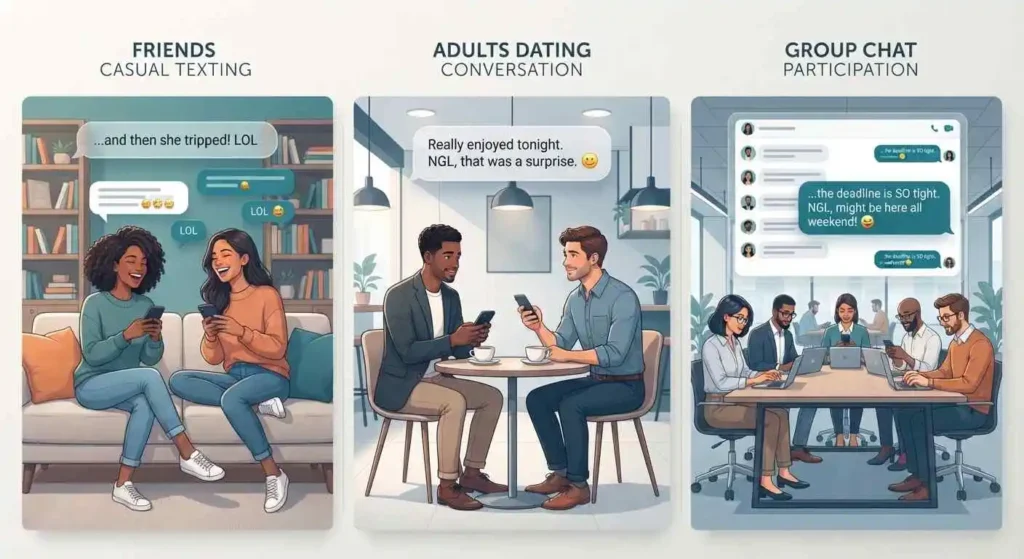
From a Friend
A friend may use slang simply to sound relaxed.
“IDK lol, you pick.”
This usually reads as casual rather than serious.
From a Guy or Girl
The gender of the person sending slang does not automatically give the term a different meaning.
For example, LOL still generally indicates laughter whether it comes from a guy or a girl.
The surrounding message matters more than gender.
From a Crush
Slang can appear in a romantic conversation, but the slang itself does not prove romantic interest.
For example:
“NGL, I had fun tonight.”
The message may feel warm depending on the conversation, but you need the broader context to determine the person’s intention.
In Dating
Dating conversations often use casual shorthand such as wyd, rn, lol, fr, hmu, or idk.
The relationship between the people and the complete conversation can affect how a short message feels.
In a Group Chat
A term such as LOL or IKR can function as a quick reaction to another person’s message.
In Social Media Comments
Short slang can show agreement, amusement, surprise, or approval.
“FR 😂”
The meaning is easier to understand when you consider the comment being responded to.
Real Chat Examples
Here are realistic examples showing how everyday chat slang can appear in conversations:

- “LOL, I can’t believe you actually did that.”
Here, LOL signals laughter or amusement. - “BRB, someone’s at the door.”
BRB tells the other person the sender is temporarily leaving the conversation. - “IDK what movie we should watch.”
IDK means the sender does not know. - “BTW, we’re meeting at 7.”
BTW introduces an additional piece of information. - “OMG, that’s so cute.”
OMG expresses surprise or excitement. - “TBH, I liked the first one better.”
TBH introduces an honest opinion. - “Are you busy RN?”
RN means right now. - “TTYL, I have to go.”
TTYL means the sender plans to talk later. - “NGL, that was better than I expected.”
NGL introduces a candid statement. - “LMK when you get home.”
LMK means let me know. - “WDYM? I thought we agreed.”
WDYM means what do you mean? - “IKR? That was hilarious.”
IKR expresses agreement with what someone just said. - “FR, you should try it.”
FR means for real and emphasizes agreement or sincerity. - “FYI, the store closes at 9.”
FYI introduces useful information. - “OMW, see you in five.”
OMW means on my way. - “LOL I completely forgot.”
LOL can soften an admission or make it feel more playful. - “IDK lol, maybe tomorrow.”
The combination makes the response feel casual and uncertain. - “BRB 😂”
A short message indicating the person will return shortly. - “NGL, I was nervous.”
NGL signals that the sender is being candid. - “LMK if you want to come.”
LMK asks the other person to tell the sender their decision.
How to Reply to Everyday Chat Slang
Because Everyday Chat Slang is a broad category, your response should depend on the specific slang being used.
Casual Replies
For a simple conversation, match the relaxed tone.
“Lol yeah”
“Gotcha”
“Same 😂”
“Sounds good”
Friendly Replies
When someone uses slang in a friendly conversation, you can respond naturally without copying every abbreviation.
“Haha, I know what you mean.”
“Yeah, totally.”
“For sure, I’ll let you know.”
Funny Replies
If the conversation is playful, humor can fit naturally.
“You really had to hit me with the LOL 😂”
“Okay, translator mode activated.”
Neutral Replies
If you are unsure about the tone, keep your answer straightforward.
“What do you mean?”
“Okay, thanks for letting me know.”
“Got it.”
Flirty or Relationship Replies
When slang appears in a romantic conversation, respond to the actual message rather than assuming the slang itself is flirtatious.
“Haha, I had fun too.”
“You can tell me more when I see you.”
“Okay, now I’m curious 👀”
What Tone Does Everyday Chat Slang Have?
Everyday chat slang is generally casual and informal.
Individual terms can add different tones:
- LOL — humorous or lighthearted
- TBH — candid or direct
- NGL — candid or conversational
- IDK — uncertain or casual
- OMG — surprised or excited
- BRB — practical and casual
- FR — emphatic or agreeing
- WDYM — questioning or clarifying
- IKR — agreement and shared reaction
Context matters. For example, “K” can sometimes feel brief or cold, but a short response does not automatically mean someone is angry. Their normal texting style and the surrounding conversation matter.
Is Everyday Chat Slang Rude or Offensive?
Everyday Chat Slang is not inherently rude or offensive. Most common texting abbreviations are simply informal ways of communicating.
They are usually appropriate for:
- Friends
- Family
- Casual texts
- Group chats
- Social media
- Informal DMs
For school, work, customer communication, applications, or other formal situations, standard language is usually safer unless the setting clearly allows casual messaging.
Some individual slang terms can be vulgar, insulting, or offensive, so you should consider the specific term rather than assuming all chat slang has the same level of formality.
Other Meanings of Everyday Chat Slang
There is no major alternative acronym expansion for the phrase Everyday Chat Slang itself.
However, individual expressions within the category can have multiple meanings. For example, an abbreviation may mean one thing in ordinary texting and something different in gaming, work, technology, or another specialized setting.
This is why reading the complete message is important before choosing a definition.
Common Mistakes About Everyday Chat Slang
Treating the Phrase Like an Acronym
“Everyday Chat Slang” is a descriptive category, not an acronym with one official full form.
Assuming Every Short Form Has One Meaning
Some abbreviations have multiple legitimate interpretations. The surrounding sentence can determine which meaning makes sense.
Assuming Slang Reveals Romantic Intent
A message containing LOL, FR, NGL, RN, or another casual term does not automatically indicate flirting or attraction.
Ignoring the Conversation
Reading an abbreviation by itself can lead to a wrong interpretation. Consider what was said immediately before it.
Using Casual Slang in Formal Communication
A phrase that works perfectly in a group chat may not be appropriate in a professional email or formal document.
Everyday Chat Slang and Related Terms
| Term | Meaning | Common Use |
|---|---|---|
| Texting slang | Informal language used in text messages | SMS and messaging |
| Internet slang | Informal language used online | Social media and online communities |
| Texting abbreviation | A shortened form of a word or phrase | Text messages |
| Chat shorthand | Compressed language used in chats | DMs and group chats |
| Initialism | A shortened expression formed from initial letters | LOL, IDK, BTW |
| Acronym | A shortened expression formed from letters, often pronounced as a word | Some online terms and general language |
These terms overlap, but they are not always interchangeable. Everyday chat slang can include abbreviations as well as ordinary slang words and informal expressions.
People Also Ask About Everyday Chat Slang
What is an example of everyday chat slang?
Common examples include LOL, BRB, IDK, BTW, TBH, OMG, RN, TTYL, NGL, and LMK. They are commonly used to shorten familiar expressions or make casual messages feel more conversational.
Is Everyday Chat Slang an acronym?
No. Everyday Chat Slang is not an acronym with a standard expansion. It is a descriptive phrase for informal language used in everyday digital conversations.
Why do people use chat slang?
People use chat slang to communicate quickly and casually. Short forms can make messages easier to type and can also give a conversation a relaxed, conversational feel.
Is texting slang the same as internet slang?
They overlap, but they are not exactly the same. Texting slang specifically relates to messaging, while internet slang can also include language used in comments, posts, gaming communities, memes, and other online spaces.
Can chat slang have different meanings?
Yes. Some abbreviations have multiple meanings, and context can determine which interpretation fits. The topic, sentence, audience, and platform can all help clarify the intended meaning.
Is chat slang appropriate at work?
It depends on the workplace and the specific message. Familiar abbreviations may be acceptable in a casual team chat, while formal emails, applications, reports, and professional documents generally call for standard language.
Does chat slang mean someone is flirting?
Not by itself. A slang term may appear in a flirtatious conversation, but the term alone does not establish romantic interest. The full conversation and relationship context provide stronger clues.
Conclusion
Everyday Chat Slang is a broad term for informal words, abbreviations, shorthand, and expressions used in digital conversations. It does not have a single full form because it describes a category rather than one acronym.
Common examples include LOL, BRB, IDK, BTW, TBH, OMG, RN, TTYL, NGL, and LMK. These expressions are mainly suited to casual texts, DMs, group chats, social media, and other informal communication. Their exact tone depends on context, so the safest way to understand slang is to consider the entire message rather than one abbreviation in isolation.

For three and a half years, Charlotte Reed has worked as a writer shaping puns and jokes around distinct subjects and vocabulary. She covers food, animals, seasonal themes, technology, entertainment, and trending topics. Her process includes examining topic-specific language, building wordplay from relevant terms, and editing punchlines for sharper phrasing, structure, and comedic timing.